As the Pressure of a System Changes, Boiling Points Can Change in What Direction?
Liquid to Gas Phase Transition
Vaporization of a sample of liquid is a stage transition from the liquid stage to the gas phase.
Learning Objectives
Depict the procedure of vaporization.
Key Takeaways
Fundamental Points
- Evaporation is a phase transition from the liquid phase to the gas stage that occurs at temperatures below the boiling point at a given pressure.
- For molecules of a liquid to evaporate, they must be located near the surface, exist moving in the proper direction, and have sufficient kinetic energy to overcome liquid-phase intermolecular forces.
- Boiling is a phase transition from the liquid phase to the gas phase that occurs at or above the humid temperature.
- Boiling is the rapid vaporization of a liquid and occurs when a liquid is heated to its humid betoken. A liquid's boiling point is the temperature at which the vapor pressure of the liquid is equal to the pressure level exerted on the liquid by the surrounding surround (air).
Key Terms
- Vaporization: Vaporization is a stage transition from the liquid stage to the gas phase.
- manometer: An instrument to measure force per unit area in a fluid, especially a double-legged liquid column gauge used to measure the difference in the pressures of 2 fluids.
- Boiling: Boiling is the rapid vaporization of a liquid and occurs when a liquid is heated to its boiling betoken, or the temperature at which the vapor pressure level of the liquid is equal to the pressure exerted on the surface of the liquid by the surrounding atmospheric gas (air).
- Evaporation: A type of vaporization of a liquid that only occurs on the liquid's surface.
Phase Transition: Liquid to Gas
Vaporization of a sample of liquid is a phase transition from the liquid stage to the gas phase. In that location are two types of vaporization: evaporation and boiling.
- Evaporation occurs at temperatures beneath the boiling point, and occurs on the liquid'due south surface. For molecules of a liquid to evaporate, they must be located well-nigh the surface, be moving in the proper direction, and accept sufficient kinetic energy to overcome intermolecular forces present in the liquid stage.
- Boiling, past contrast, is a rapid vaporization that occurs at or above the humid temperature and at or below the liquid'south surface.
Vapor Pressure
In much the aforementioned way that tea spreads out from a tea bag once the bag is immersed in h2o, molecules that are confined within a stage will tend to spread themselves (and the thermal free energy they deport with them) as widely as possible. This fundamental law of nature is manifested in what is called the "escaping tendency" of the molecules from the phase. The escaping trend is of primal importance in agreement all chemical equilibria and transformations.
It is possible to detect the trend of molecules to escape into the gas phase from a solid or liquid by placing the substance in a airtight, evacuated container connected to a manometer for measuring gas pressure.
If this is washed with water, the partial pressure level of water Pdue west in the space above the liquid will initially be cypher (step one). Gradually, Pw will rising every bit molecules escape from the liquid phase and enter the vapor phase. At the same time, some of the vapor molecules volition condense dorsum into the liquid stage (pace two). Because this latter process is less favorable (at the particular temperature represented here), Pw continues to ascent equally more water vapor forms. Eventually a balance is reached between the 2 processes (step 3), and Pwest stabilizes at a fixed, or equilibrium, value Pvap, which depends on the substance and temperature. Pvap is known as the "equilibrium vapor force per unit area", or simply as the "vapor force per unit area" of the liquid. The vapor pressure is a direct measure of the escaping tendency of molecules from a condensed state of thing.
Boiling
The boiling point is the temperature at which the vapor pressure level of the liquid is equal to the pressure exerted on the liquid past the surrounding environs (air). The escaping trend of molecules from a phase ever increases with temperature; therefore, the vapor pressure level of a liquid volition exist greater at higher temperatures. The variation of vapor pressure with temperature is not linear. Because the typical pressure at the earth'due south surface is one atm (760 torr), this is the vapor pressure that a liquid must equal in order for it to be at its normal boiling signal.
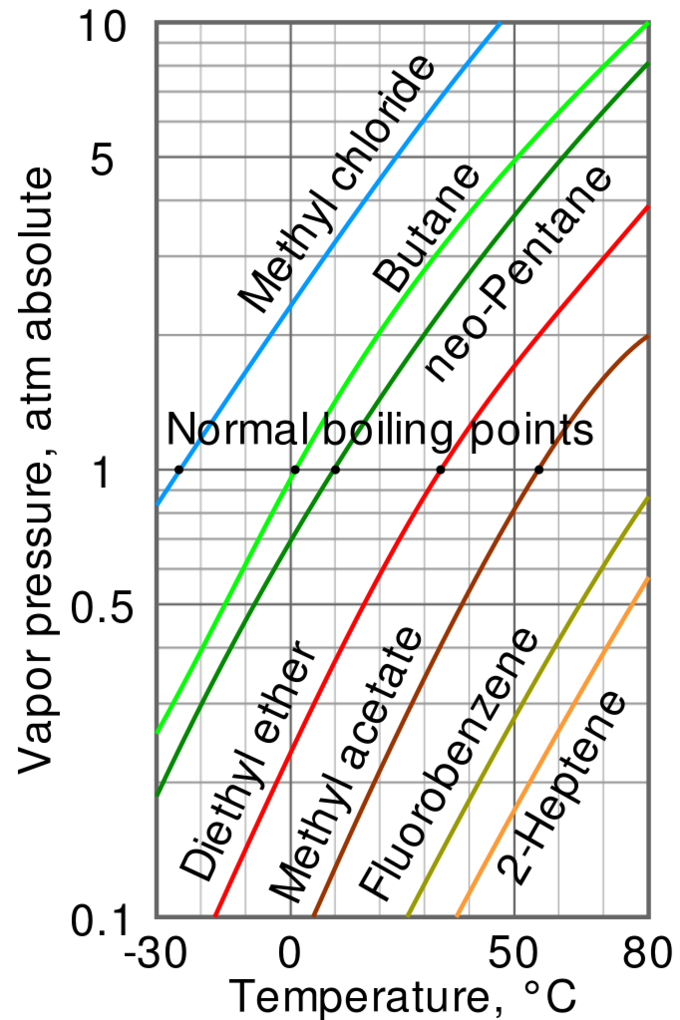
Vapor force per unit area and temperature: The variation of vapor pressure with temperature is not linear. The intercepts of each bend with the horizontal line at 1 atm (i.e. 760 torr) indicate the normal boiling betoken of each liquid, ranging from -25 °C for methyl chloride to over 80 °C for fluorobenzene and 2-heptene.
The curve suggests that when the atmospheric pressure is lower than 1 atm (for instance, at higher altitudes), then the boiling indicate will occur at lower temperatures. This is considering the liquid can be heated less in order for its vapor pressure to equal the atmospheric pressure. This has indeed been observed to be truthful.
Related Phenomena Involving The Liquid Purlieus Curvature
The vapor pressure of a liquid is determined by the bonny forces that act on the molecules at the surface of a liquid. In a very minor driblet, the liquid surface is curved in such a manner that each molecule experiences fewer nearest-neighbor attractions than is the case for the bulk liquid. The outermost molecules of the liquid are jump to the droplet less tightly, and the drop has a larger vapor pressure than does the majority liquid. If the vapor force per unit area of the drop is greater than the partial force per unit area of vapor in the gas phase, the driblet will evaporate.
Interactive: Boiling Betoken: Non-polar molecules (grayness) evaporate or boil more than quickly than polar molecules (blue and red). Attractions betwixt molecules are shown with dotted lines. Run the model, so heat the liquids. What does boiling look like at the molecular level?
A bubble is a hole in a liquid; molecules at the liquid boundary are curved inward, so they experience stronger nearest-neighbor attractions. As a consequence, the vapor pressure Pwest of the liquid facing into a bubble is always less than that of the majority liquid Pdue west at the aforementioned temperature. When the bulk liquid is at its normal boiling signal (that is, when its vapor pressure is ane atm), the force per unit area of the vapor inside the chimera will exist less than 1 atm, so the bubble will tend to collapse. As well, since the chimera is formed within the liquid, the hydrostatic pressure of the overlaying liquid will add to this effect. For both of these reasons, a liquid will not boil until the temperature is raised slightly above the boiling point, a miracle known equally superheating. In one case the boiling begins, information technology volition go along to do so at the liquid'southward proper boiling point.
Supercritical Fluids
A supercritical fluid is a substance at a temperature and pressure above its critical signal, where distinct liquid and gas phases do non exist.
Learning Objectives
Discuss the properties of supercritical fluids.
Central Takeaways
Primal Points
- Supercritical fluids have properties between those of a gas and a liquid.
- A supercritical fluid tin can effuse through solids like a gas and deliquesce materials like a liquid.
- All supercritical fluids are completely miscible with each other, then for a mixture a unmarried phase can be guaranteed, if the critical point of the mixture is exceeded.
Cardinal Terms
- supercritical fluid: Whatever substance at a temperature and force per unit area above its critical point, where distinct liquid and gas phases do not exist.
- critical temperature: The temperature beyond which no phase boundaries exist for a given substance.
- critical point: Besides known as a disquisitional land, this bespeak occurs under conditions (such as specific values of temperature, pressure, or composition) at which no stage boundaries exist.
- disquisitional pressure: The pressure across which no phase boundaries exist for a given substance.
Properties of Supercritical Fluids
A supercritical fluid is whatever substance at a temperature and pressure level to a higher place its disquisitional point, where distinct liquid and gas phases do non be. This can be rationalized by thinking that at high enough temperatures (above the critical temperature ) the kinetic energy of the molecules is high plenty to overcome whatsoever intermolecular forces that would condense the sample into the liquid phase. On the other hand, high enough pressures (above the critical pressure ) would non allow a sample to stay in the pure gaseous state. Therefore, a residual between these two tendencies is achieved and the substance exists in a state between a gas and a liquid.
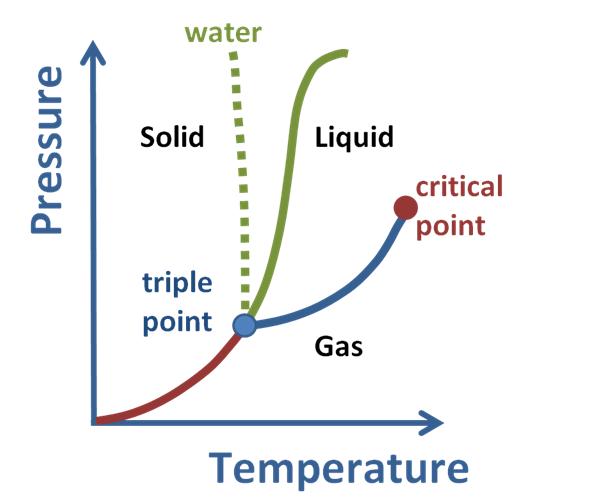
Stage Diagram for a Substance: The effigy highlights the critical point, above which (in either temperature or pressure) the substance does not be in either the liquid or gas phase. Nether those conditions it is chosen a "supercritical fluid," and has backdrop betwixt those of a liquid and a gas.
It can effuse through solids (similar a gas), and deliquesce materials (like a liquid). In addition, close to the critical betoken, small changes in pressure or temperature outcome in large changes in density, allowing many properties of a supercritical fluid to be "fine-tuned. " Supercritical fluids are suitable as a substitute for organic solvents in a range of industrial and laboratory processes. Carbon dioxide and water are the almost ordinarily used supercritical fluids, as they are used for decaffeination and power generation, respectively.
In general terms, supercritical fluids have backdrop betwixt those of a gas and a liquid. The critical properties of some substances used as solvents and equally supercritical fluids are shown in Tabular array 1. Table two shows density, diffusivity, and viscosity for typical liquids, gases, and supercritical fluids.
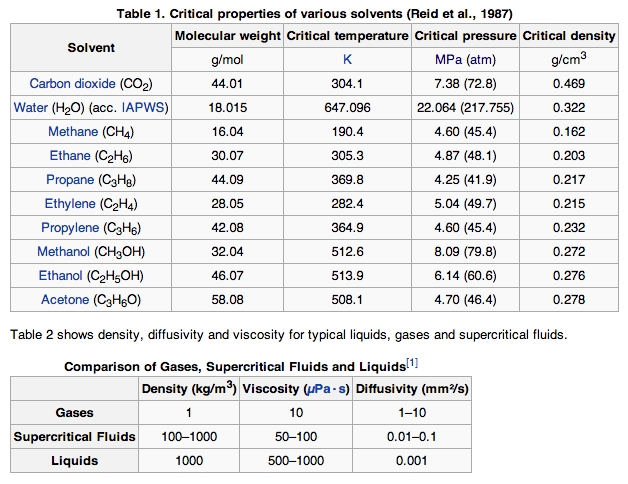
Critical Backdrop of Various Solvents: Supercritical fluids have properties between those of a gas and a liquid.
In addition, there is no surface tension in a supercritical fluid, every bit there is no liquid to gas phase boundary. Past changing the pressure and temperature of the fluid, the properties can be "tuned" to exist more than liquid- or gas-like. One of the almost important properties of supercritical fluids is their ability to act as solvents. Solubility in a supercritical fluid tends to increase with the density of the fluid (at constant temperature). Since density increases with pressure level, solubility tends to increase with pressure level.
The relationship with temperature is a little more complicated. At constant density, solubility will increase with temperature. However, shut to the critical point, the density tin can driblet sharply with a slight increase in temperature. Therefore, close to the critical temperature, solubility oft drops with increasing temperature, then rises again.
All supercritical fluids are completely miscible with each other; therefore a single phase for a mixture can be guaranteed if the critical point is exceeded. The critical bespeak of a binary mixture tin can be estimated as the arithmetics mean of the critical temperatures and pressures of the two components,
Tc(mix) = (mole fraction of A) x T c( A) + (mole fraction of B) ten T c( B)
For greater accurateness, the critical point can be calculated using equations of state, such as the Peng Robinson or group contribution methods. Other properties, such as density, can too be calculated using equations of state.
Example Report: Carbon Dioxide
In the pressure-temperature phase diagram of COtwo, the humid separates the gas and liquid region and ends in the critical point, where the liquid and gas phases disappear to become a single supercritical phase. At well beneath the critical temperature, (e.thousand., 280 K), as the pressure increases, the gas compresses and eventually (at just over forty bar) condenses into a much denser liquid, resulting in the discontinuity in the line (vertical dotted line). The system consists of 2 phases in equilibrium, a dense liquid and a low density gas.
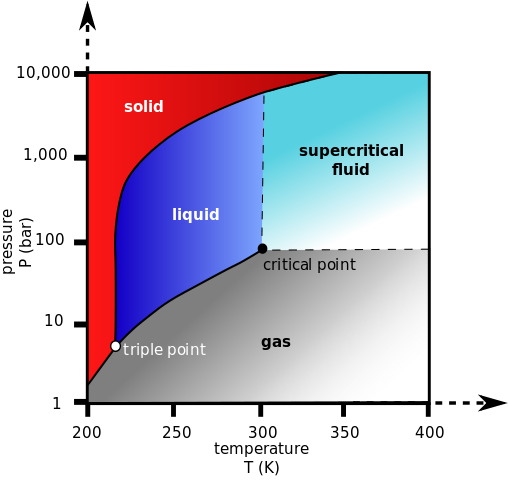
Phase Diagram for Carbon Dioxide: This diagram indicates the supercritical fluid region of CO2.
Every bit the critical temperature is approached (300 G), the density of the gas at equilibrium becomes denser, and that of the liquid becomes lower. At the disquisitional point, (304.1 K and 7.38 MPa) there is no difference in density, and the two phases become one fluid phase. Thus, above the critical temperature a gas cannot be liquified by pressure level. At slightly above the critical temperature (310 K), in the vicinity of the critical force per unit area, the line is nigh vertical. A pocket-sized increase in pressure level causes a large increase in the density of the supercritical phase. Many other concrete properties too show big gradients with force per unit area near the disquisitional betoken, such equally viscosity, the relative permittivity, and the solvent forcefulness, which are all closely related to the density.
Liquid to Solid Phase Transition
Freezing is a phase transition in which a liquid turns into a solid when its temperature is lowered to its freezing point.
Learning Objectives
Talk over the process of freezing.
Key Takeaways
Key Points
- For most substances, the melting and freezing points are the aforementioned temperature; still, certain substances possess different solid – liquid transition temperatures.
- Most liquids freeze past crystallization, the formation of a crystalline solid from the uniform liquid.
- Freezing is near ever an exothermic process, meaning that every bit liquid changes into solid, oestrus is released.
- The energy released upon freezing, known as the enthalpy of fusion, is a latent heat, and is exactly the same every bit the free energy required to cook the same amount of the solid.
Key Terms
- Freezing: Freezing or solidification is a phase transition in which a liquid turns into a solid when its temperature is lowered to its freezing bespeak.
- Nucleation: In the context of freezing, nucleation is the localized budding of a crystalline solid structure.
Freezing, or solidification, is a phase transition in which a liquid turns into a solid when its temperature is lowered to or below its freezing point. All known liquids, except helium, freeze when the temperature is low enough. (Liquid helium remains a liquid at atmospheric pressure even at absolute nil, and can be solidified only under college pressure.)
For almost substances, the melting and freezing points are the aforementioned temperature; nevertheless, certain substances possess different solid-liquid transition temperatures. For example, agar displays a hysteresis in its melting and freezing temperatures: it melts at 85 °C (185 °F) and solidifies between 31 °C and xl °C (89.6 °F to 104 °F).
Most liquids freeze by crystallization, the germination of a crystalline solid from the compatible liquid.
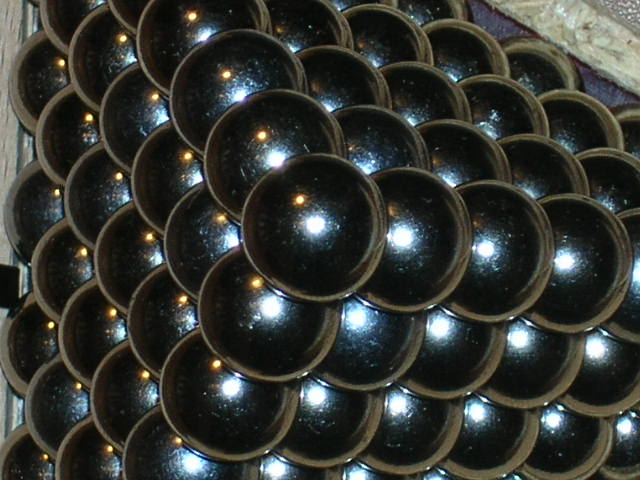
Crystalline Solid: Model of closely packed atoms within a crystalline solid.
Nucleation
This is a outset-order thermodynamic stage transition, which ways that every bit long as solid and liquid coexist, the equilibrium temperature of the system remains constant and equal to the melting point. Crystallization consists of two major events: nucleation and crystal growth. Nucleation is the step in which the molecules start to assemble into clusters (on the scale of nanometers), arranging themselves in the periodic design that defines the crystal structure. The crystal growth is the subsequent growth of the nuclei that succeed in achieving and surpassing the disquisitional cluster size.
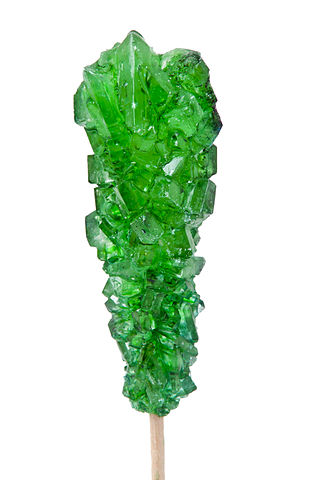
Nucleation Leads to Crystal Formation: When sugar is supersaturated in water, nucleation will occur, allowing sugar molecules to stick together and form large crystal structures.
Crystallization of pure liquids usually begins at a lower temperature than the melting point, due to the high activation energy of homogeneous nucleation. The creation of a nucleus implies the formation of an interface at the boundaries of the new phase. Some free energy is expended to class this interface, based on the surface energy of each phase. If a hypothetical nucleus is too small-scale, the free energy that would be released by forming its volume is not enough to create its surface, and nucleation does not proceed. Freezing does not outset until the temperature is low enough to provide enough energy to course stable nuclei.
In the presence of irregularities on the surface of the containing vessel, solid or gaseous impurities, pre-formed solid crystals, or other nucleators, heterogeneous nucleation may occur. Heterogeneous nucleation is when nucleation occurs on a surface that the substance is in contact with.
The melting point of h2o at 1 atmosphere of pressure is very close to 0 °C (32 °F, 273.15 1000), and in the presence of nucleating substances the freezing indicate of water is close to the melting point. Even so, in the absence of nucleators water tin supercool to -40 °C (-40 °F, 233 Yard) before freezing. Under high pressure (2,000 atmospheres), water will supercool to as low as -70 °C (-94 °F, 203 Yard) before freezing.
Freezing is Accompanied by Release of Rut
Freezing is well-nigh always an exothermic process, meaning that as liquid changes into solid, estrus is released. This may seem counterintuitive, since the temperature of the material does not rise during freezing (except if the liquid is supercooled). But heat must be continually removed from the freezing liquid, or the freezing process volition stop. The free energy released upon freezing, known equally the enthalpy of fusion, is a latent heat and is exactly the same as the energy required to melt the same corporeality of the solid.
Interactive: Phase Change: Matter exists as solids, liquids and gases, and can change state between these. The model shows a liquid material on the left (small atoms). The amount of heat free energy is shown by kinetic energy (KE) shading, with deeper shades of red representing more energetic atoms. On the right side of the bulwark is a solid material (big atoms). Run the model. How much energy is able to penetrate the barrier? Remove the bulwark. How quickly practice the more energetic atoms cook the solid?
Solid to Gas Stage Transition
Sublimation is the phase transition from the solid to the gaseous stage, without passing through an intermediate liquid phase.
Learning Objectives
Discuss the process of sublimation.
Key Takeaways
Key Points
- Sublimation is an endothermic phase transition in which a solid evaporates to a gas.
- Solids that sublimate accept such high vapor pressures that heating leads to a substantial vaporization even before the melting point is reached.
- The enthalpy of sublimation (also called rut of sublimation) tin exist calculated every bit the sum of the enthalpy of fusion and the enthalpy of vaporization.
Key Terms
- sublimation: The process of transformation directly from the solid to the gaseous phase, without passing through an intermediate liquid stage.
- Triple point: In thermodynamics, the triple point of a substance is the temperature and pressure level at which the three phases (gas, liquid, and solid) coexist in thermodynamic equilibrium.
- degradation: A phase transition in which a gas is converted to solid, without passing though an intermediate liquid phase. It is the reverse process of sublimation.
Phase Transition: Solid to Gas
Sublimation is the process of transformation directly from the solid stage to the gaseous phase, without passing through an intermediate liquid phase. Information technology is an endothermic stage transition that occurs at temperatures and pressures beneath a substance 'southward triple point (the temperature and pressure level at which all three phases coexist) in its phase diagram.
At a given temperature, most chemical compounds and elements tin can possess ane of the three different states of thing at different pressures. In these cases, the transition from the solid to the gaseous state requires an intermediate liquid state. But at temperatures below that of the triple betoken, a decrease in pressure will issue in a stage transition directly from the solid to the gaseous. Besides, at pressures beneath the triple indicate pressure, an increment in temperature volition result in a solid being converted to gas without passing through the liquid region.
Phase Diagram of a Pure Substance: Notice the triple point of the substance. At temperatures and pressures below those of the triple point, a phase alter between the solid and gas phases can take place.
For some substances, such as carbon and arsenic, sublimation is much easier than evaporation. This is considering the pressure of their triple signal is very high and it is difficult to obtain them as liquids. The solid has such high vapor pressures that heating leads to a substantial corporeality of straight vaporization even before the melting point is reached.
The procedure of sublimation requires additional energy and is therefore an endothermic change. The enthalpy of sublimation (too called heat of sublimation) tin can be calculated equally the sum of the enthalpy of fusion and the enthalpy of vaporization.
The reverse process of sublimation is deposition (i.east., gas to solid). For example, solid iodine, I2, is easily sublimed at temperatures around 100°C. Even ice has a measurable vapor pressure nearly its freezing signal, as evidenced by the tendency of snow to evaporate in cold dry weather condition. There are other solids whose vapor pressure overtakes that of the liquid before melting can occur. Such substances sublime; a mutual instance is solid carbon dioxide (dry ice) at 1 atm of atmospheric pressure.
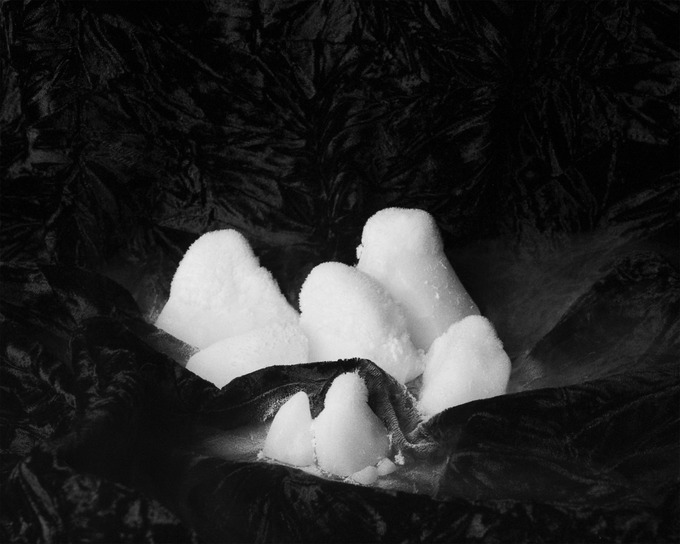
Dry out Ice: Solid carbon dioxide (known as "dry ice") sublimes into the air.
Heating Bend for H2o
H2o transitions from ice to liquid to water vapor equally heat is added to it.
Learning Objectives
Talk over the heating curve for h2o.
Key Takeaways
Fundamental Points
- A heating curve graphically represents the phase transitions that a substance undergoes as heat is added to information technology.
- The plateaus on the curve mark the phase changes. The temperature remains constant during these stage transitions.
- Water has a loftier boiling point because of the stiff hydrogen bonds between the water molecules; it is both a strong hydrogen bond donor and acceptor.
- The first change of phase is melting, during which the temperature stays the same while water melts. The 2nd change of phase is boiling, as the temperature stays the aforementioned during the transition to gas.
Key Terms
- hydrogen bond: A strong intermolecular bail in which a hydrogen cantlet in one molecule is attracted to a highly electronegative atom (usually nitrogen or oxygen) in a unlike molecule.
- specific heat capacity: The corporeality of oestrus needed to raise the temperature of 1 g of a substance past 1 degree Celsius.
Like many substances, water can exist in dissimilar phases of affair: liquid, solid, and gas. A heating bend shows how the temperature changes as a substance is heated up at a abiding rate.
Cartoon a Heating Curve
Temperature is plotted on the y-axis, while the x-axis represents the heat that has been added. A constant rate of heating is assumed, so that 1 tin also think of the ten-axis every bit the amount of time that goes by as a substance is heated. There are two main observations on the measured curve:
- regions where the temperature increases as heat is added
- plateaus where the temperature stays constant.
Information technology is at those plateaus that a phase alter occurs.
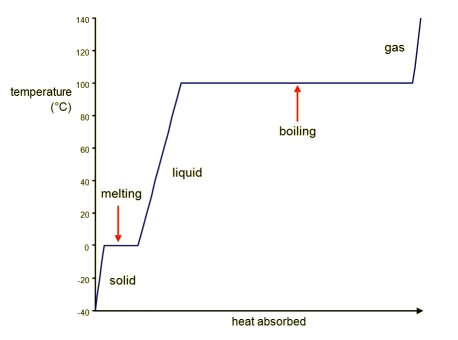
Heating Curve of Water: The phase transitions of water.
Assay of a Heating Curve
Looking from left to right on the graph, there are five singled-out parts to the heating curve:
- Solid ice is heated and the temperature increases until the normal freezing/melting point of zip degrees Celsius is reached. The amount of oestrus added, q, tin be computed past: [latex]\text{q}=\text{m}\cdot \text{C}_{\text{H}_2\text{O}(\text{southward})}\cdot \Delta \text{T}[/latex], where m is the mass of the sample of h2o, C is the specific heat capacity of solid h2o, or ice, and [latex]\Delta \text{T}[/latex] is the change in temperature during the process.
- The first stage alter is melting; as a substance melts, the temperature stays the same. For water, this occurs at 0o C. The above equation (described in part 1 of the curve) cannot be used for this function of the curve because the change in temperature is zilch! Instead, use the rut of fusion ([latex]\Delta \text{H}_{\text{fusion}}[/latex] ) to calculate how much heat was involved in that process: [latex]\text{q}=\text{m}\cdot \Delta \text{H}_{\text{fusion}}[/latex], where m is the mass of the sample of h2o.
- After all of the solid substance has melted into liquid, the temperature of the liquid begins to increase as heat is captivated. Information technology is then possible to calculate the heat captivated by: [latex]\text{q}=\text{m}\cdot \text{C}_{\text{H}_2\text{O}(\text{l})}\cdot \Delta \text{T}[/latex]. Note that the specific heat capacity of liquid h2o is unlike than that of water ice.
- The liquid will brainstorm to boil when enough oestrus has been absorbed by the solution that the temperature reaches the humid point, where once more, the temperature remains constant until all of the liquid has become gaseous water. At the atmospheric pressure of 1 atm, this phase transition occurs at 100o C (the normal boiling betoken of water). Liquid water becomes water vapor or steam when it enters the gaseous phase. Utilize the oestrus of vaporization ([latex]\Delta \text{H}_{\text{vap}}[/latex] ) to summate how much rut was captivated in this procedure: [latex]\text{q}=\text{thousand}\cdot \text{C}_{\text{H}_2\text{O}(\text{g})}\cdot \Delta \text{T}[/latex], where yard is the mass of the sample of water.
- After all of the liquid has been converted to gas, the temperature will continue to increment equally heat as added. Again, the heat added that results in a sure change temperature is given past: [latex]\text{q}=\text{1000}\cdot \text{C}_{\text{H}_2\text{O}(\text{g})}\cdot \Delta T[/latex]. Note that the specific heat capacity of gaseous water is different than that of ice or liquid h2o.
- Water has a loftier boiling bespeak considering of the presence of extensive hydrogen bonding interactions betwixt the water molecules in the liquid phase (water is both a strong hydrogen bail donor and acceptor). When heat is first applied to water, it must break the intermolecular hydrogen bonds within the sample. After breaking the bonds, heat is then absorbed and converted to increased kinetic energy of the molecules in order to vaporize them.
Source: https://courses.lumenlearning.com/boundless-chemistry/chapter/phase-changes/
0 Response to "As the Pressure of a System Changes, Boiling Points Can Change in What Direction?"
Post a Comment