Teachers ask high court to hear union dues case
Courtesy of Greg Schneider (www.gregschneider.com)
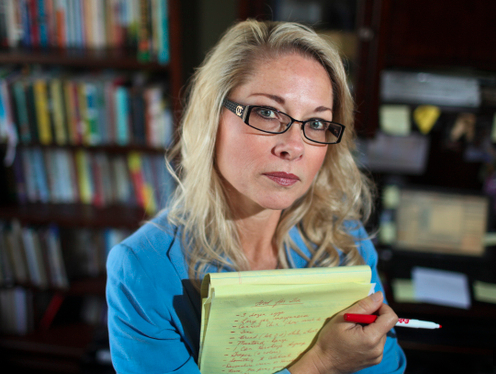
Rebecca Friedrichs, lead plaintiff in Friedrichs 5. California Teachers Association.
 Courtesy of Greg Schneider (www.gregschneider.com)
Rebecca Friedrichs, lead plaintiff in Friedrichs v. California Teachers Association.
Attorneys for teachers who are challenging the right of the California Teachers Clan to forcefulness them to pay union dues petitioned the U.S. Supreme Courtroom on Monday to hear their case this twelvemonth. There's a good run a risk that it will.
In Friedrichs 5. CTA, 10 California public schoolhouse teachers and the teachers group, Christian Educators Clan International, argue that the land law allowing public unions to charge all employees fees to correspond them violates their First Amendment speech rights. Victory in the Supreme Courtroom would overturn similar laws in 25 other states and could severely weaken public employee unions' ascendancy by making all members' dues voluntary. Two years after legislators rescinded Wisconsin'due south mandatory ante laws, a third of that country'south teachers had stopped paying ante.
The U.S. Supreme Court has already ruled in the 1977 instance Abood v. Detroit Board of Education that teachers don't accept to pay that portion of dues that goes to political purposes, including electing candidates. That's thirty to 40 percent of the approximately $1,000 in dues that California teachers pay annually.
But the Abood determination, which simple schoolhouse teacher Rebecca Friedrichs, of the Savanna School District in Anaheim, is challenging, also said states could require public employees to pay "agency fees." That portion, with a slice going to CTA's parent wedlock, the National Didactics Association, covers negotiations for workplace weather, pay and benefits, including lobbying in Sacramento and Washington, D.C., involving those matters.
Bureau fees protect against "free riders," those who'd weaken the ability of unions to correspond members by going along for the ride without paying. Requiring union members to cover negotiations is no more than coercive than requiring people to pay taxes when they disagree with how government spends some of the money, Harvard Police force School professor Laurence Tribe argued last year in a mag article.
But the Center for Individual Rights in Washington, D.C., which brought the lawsuit for Friedrichs and the other plaintiffs, argues that public employee unions' commonage bargaining by its nature is "cadre political speech indistinguishable from lobbying." Teachers who disagree over a union's positions not only on pay and benefits simply also policy issues involving tenure, class size and teacher evaluations should not be forced to subsidize those views, the center states.
"There is no principal way to resolve the disagreements," Terry Pell, president of the Middle for Private Rights, said in an interview. "Everything the matrimony does is political."
Supreme Courtroom Justice Samuel Alito appears to agree. Writing for the 5-iv majority last year in in Harris 5. Quinn, a narrow decision involving Illinois health-care workers, Alito referred to the "questionable foundations" of the Abood decision and appeared to encourage a broader case raising the Start Amendment bug.
Friedrichs would appear to qualify. Filed in 2013, the lawsuit sped through federal district court and the U.S. ninethursday Circuit Court of Appeals, both of which expedited information technology at the plaintiffs' asking, out of recognition that it'south a affair for the U.S. Supreme Court to decide.
If the Supreme Court won't fully overturn Abood, the teachers have a fallback asking: throw out California'due south law that requires employees to annually opt out of the dues portion going to political purposes. Saying it puts too much brunt on teachers, the lawsuit wants an opt-in system, with the onus on a union to sign up employees willing to chip in.
It takes 4 of nine Supreme Court judges to concord to hear a case. Pell is confident they volition do so and hear oral arguments in the autumn, with a decision likely in 2016.
To get more reports like this 1, click here to sign up for EdSource'southward no-toll daily email on latest developments in teaching.
Source: https://edsource.org/2015/teachers-ask-high-court-to-hear-union-dues-case/73528
0 Response to "Teachers ask high court to hear union dues case"
Post a Comment